End of an Era from Priscilla Lavakula on Vimeo.
Showing posts with label Pt England School. Show all posts
Showing posts with label Pt England School. Show all posts
Thursday, 15 December 2016
End of an Era
This is my final post as a teacher at Point England School. I have been at Point England school since 2006 and have learned a great deal. Thank you to Russell and Dorothy Burt and all the staff for their support and leadership. Thank you to the office/ admin staff who are the backbone of the school. Thanks to all the support staff for their help throughout the years. Thank you to parents for allowing me to teach your children. Thank you most of all to the children, who as much as I have taught I've also learned from you. I will take a bit of Point England with me. I'll still be posting to my inquiry blog. Thanks Point England, I love you all.

Monday, 5 December 2016
End of Year Reading Data
Here is a deeper look into the end of year data collected over the year. Looking closer at the data helps to determine why shifts were made or not and where to next.
Sunday, 18 September 2016
Inquiry Update: Change in Pedagogy
My focus around what the children are reading in class has changed. Yes, I still need to have a followup for each group but because of what we're doing in our team in reading, has changed so has the focus, slightly.
Team 4 teachers and I decided to have mini topics under the school inquiry. The topic for this term is the Olympics and we looked at it from a point of view as the: Olympics Exposed. This meant that we were teaching children what goes on behind the scenes of the Olympics. I hadn't really thought about that point of view before but not only did the children learn about these mini topics, but so did I.
I'll be honest and say that it wasn't easy at first. This meant that there weren't many books or journals for children to read under these mini topics. So, as a team we had to delve into online readings. The children have one main text that they have to read but we also have also included other readings that support the main text. It's still a work in progress for myself. But as a team we are working collaboratively. I check out what others have been doing on our site and might use some readings or followup activities and make them my own.
Monday, 29 August 2016
Term 3 Inquiry Update
This term our team focus was around issues that went on behind the scenes of the Olympics, called "Olympics Uncovered". We had to teach issues that covered two to three weeks at a time. The following texts were found on Journal Surf. The focus of my mini topics were: Doping in Sport, the Zika Virus, Muscles and the Human Body and some sports. These are the books I found that specifically related to these topics.
Boost is a story about some children that had enhancements from a clinic and how they behaved in class. When children read this, they could tell that this was cheating and that it wasn't fair on others. For extended reading texts, I found articles online based on doping in sport.

Mighty Muscles is a short article that gives students a brief idea of why it is important to have healthy muscles. From observations, few children knew only one or two muscles in their body. For extended readings, I've had to search online to find articles and readings that related to the muscular system.

The texts around viruses and bacteria that I found were The good, the bad and the ugly and Double, double, toilet trouble. My top reading group are able to explain the difference between bacteria and a virus. I found articles on the Zika virus online and used these as extended texts. One teaching "a-ha!" moment is when one of my students said "oh, I didn't know that'.


Boost is a story about some children that had enhancements from a clinic and how they behaved in class. When children read this, they could tell that this was cheating and that it wasn't fair on others. For extended reading texts, I found articles online based on doping in sport.

Mighty Muscles is a short article that gives students a brief idea of why it is important to have healthy muscles. From observations, few children knew only one or two muscles in their body. For extended readings, I've had to search online to find articles and readings that related to the muscular system.


The follow up activities were based on agree/ disagree, compare and contrast and short fact presentations. Some children made advertisements about Boost and whether people should be using it or not. Check out an example here. Here's are movies made by students about the Zika Virus here and here. Here's an activity for Mighty Muscles here.
Monday, 4 July 2016
Term 2: Inquiry Update
This term I have been focussing on getting the children to think from the 'author's point of view'. The tasks I got the children to use were agreeing or disagreeing with statements. However, the children had to think from the 'author's point of view' not from their view. This was quite difficult for some children because they had to switch their thinking. It generated good discussion and healthy argument amongst the children and they had to use their books as evidence.
Thursday, 16 June 2016
LIteracy Tasks for Reading Followup
Here is a selection of followup tasks that I have been using and practicing in my classroom. Please feel free to use them if you wish. They are suitable for all reading ages and can be changed to suit your own groups.
Monday, 11 April 2016
Term One Inquiry Reflection
My focus has been having followup tasks that engage students motivation in reading. Here is what I have found out so far.
Sunday, 28 February 2016
Inquiry Focus in 2016

Wednesday, 9 December 2015
Final Inquiry Reflection for 2015
The following is data based on end of year gloss testing. This is of my maths class, a total of 28 students, nine of which were in my ALIM group.
Things that I would like to focus on for next year: sorting my groups in to mixed ability, focus on fractions and incorporating strands - geometry and statistics.
Things that I would like to focus on for next year: sorting my groups in to mixed ability, focus on fractions and incorporating strands - geometry and statistics.
Monday, 2 November 2015
Alim Impact Day Presenation
I've been privileged to have been part of the Accelerated Learning in Maths 1 programme this year.
A brief overview of the demographics of our school. We are in East Auckland and have a roll of around 650 students. The majority of the children are of Maori and Pasifika background with a small number of Asian and New Zealand European. We are a Manaiakalani cluster school and are a 1:1 digitally immersed. We base our approach on Learn, Create and Share. The resources that I used mainly were from the nzmaths site, figure it out books and the No Nonsense Maths Problem books. One activity that I felt helped with fractions was: Fraction Tagging. My focus question was: "How can I use problem solving with rich tasks to improve the learning outcomes of my target students?"
I initially chose 10 students but 1 student left so I had 9 altogether. The first week was spent setting up a treaty, creating a checklist for students to use when problem solving, having a reflection chart at the end of each lesson and sending home letters to parents.
Grouping students was important. I wanted to split children that were very chatty but also wanted confident children amongst the less confident.
I found that my "Maths Club" became more confident and began sharing their learning in class with other children. They were able to help others too. I also created a google form that I got my students to fill out. Some of the children's responses were that they really loved maths, maths was the only thing they were good at and one student loved maths because he could learn from others.
I mainly focused my teaching around fractions and proportions although I did teach multiplication and division strategies as well.
Thankfully enough, our CAP plan was already in place from previous teachers who had been through Alim so I spent some time going over it again. You'll see the data and my findings in the presentation below. If you have any questions please feel free to comment. Also thank you to Juanita and Sue for helping me along the way.
A brief overview of the demographics of our school. We are in East Auckland and have a roll of around 650 students. The majority of the children are of Maori and Pasifika background with a small number of Asian and New Zealand European. We are a Manaiakalani cluster school and are a 1:1 digitally immersed. We base our approach on Learn, Create and Share. The resources that I used mainly were from the nzmaths site, figure it out books and the No Nonsense Maths Problem books. One activity that I felt helped with fractions was: Fraction Tagging. My focus question was: "How can I use problem solving with rich tasks to improve the learning outcomes of my target students?"
I initially chose 10 students but 1 student left so I had 9 altogether. The first week was spent setting up a treaty, creating a checklist for students to use when problem solving, having a reflection chart at the end of each lesson and sending home letters to parents.
Grouping students was important. I wanted to split children that were very chatty but also wanted confident children amongst the less confident.
I found that my "Maths Club" became more confident and began sharing their learning in class with other children. They were able to help others too. I also created a google form that I got my students to fill out. Some of the children's responses were that they really loved maths, maths was the only thing they were good at and one student loved maths because he could learn from others.
I mainly focused my teaching around fractions and proportions although I did teach multiplication and division strategies as well.
Thankfully enough, our CAP plan was already in place from previous teachers who had been through Alim so I spent some time going over it again. You'll see the data and my findings in the presentation below. If you have any questions please feel free to comment. Also thank you to Juanita and Sue for helping me along the way.
Monday, 14 September 2015
Inquiry Reflection Term 3
Reflecting on what am I trying to address and what impact has it had on student's learning.
Monday, 3 August 2015
Reflecting So Far...
However, after much practice and pulling children's thinking back to the problem and what the problem is requiring them to do, facilitating discussions became easier. Once a student shared, I would give the others in the group a raised eyebrow look and that would signal to them that they needed to ask questions eg. Can you explain how you got your answer?
This rest of the group had to be listening when others were sharing. The children in my Integers group are leading their discussion when problem solving. If the problem is difficult then I would record their thinking on the whiteboard for others to see and this would apply for children that speak quickly. It helps others to take notice and think whether they agree or disagree with the speaker's thinking and answer.
This has changed my practice immensely. I am not talking or leading the discussion as much as I use too.
Where to next? I've focused a lot on teaching strategies through problem solving. I'm now going to focus on teaching number knowledge.
Monday, 27 July 2015
Stage 5 and 6 Strategies
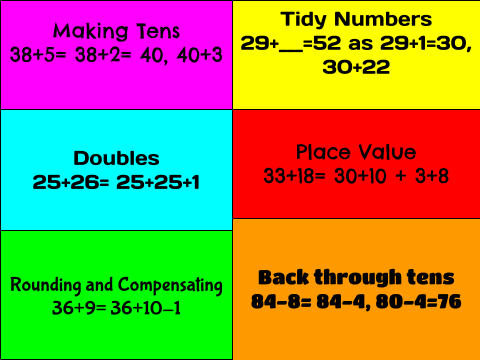
I've been teaching children to recognise the way that they solve number problems and getting them to relate them to names. At the moment both the Integers and Exponents are very familiar and are more able at using Place Value and Tidy Number strategies.
Stage 5 Strategies
Stage 6 Strategies

Stage 5 Strategies
Stage 6 Strategies
Thursday, 2 July 2015
ALIM: Accelerated Learning in Mathematics

This year, I am very fortunate to have been accepted to this programme. If you'd like to know more about it you can click here.
I have a group of 5 children that I have glossed prior to launching into teaching. My inquiry is "How will a focus on Rich Tasks in Problem Solving contribute to improved learning outcomes for my target students? I will be focusing on teaching fractions, proportions and ratios.
Monday, 29 June 2015
Term 2 Inquiry Reflection
Here is my reflection of my inquiry so far. I have included what has worked well, observations, what needs improving and where to next.
Monday, 1 June 2015
Progress with Integers Group

Without using materials children were able to solve this.
When I posed the question 53 divided by 10, Richard was able to use a different strategy and say that 50 divided by 10=5 and there were 3 left over. He knew that 5x10=50 (reversibility) and knowledge of basic facts.
Another question was 44 divided by 5. Machelle said the answer was 9 remainder 1. She said that 5x9=45-1 =44.
Richard disagreed. He said that 40 divided by 5=8 and there's 4 left over. Machelle had to repeat it back and she could see that was she had shared was incorrect. She showed understanding through discussion.
Saturday, 23 May 2015
Teaching with Integers
You said ______________________, can you explain why did you do that?
Why did you _______________________?
I don't agree because ___________________.
I didn't understand, could you repeat that please?
I also focused on not speaking too much and encouraged the children to speak instead. When a student shared their learning and ideas, I found that a lot of the children tended to agree and weren't really questioning or challenging what was shared.
However, children began to put on their thinking caps and had light bulb "a-ha!" moments. Discussions have been working really well with my Integers group. Machelle is a good example. She is always commenting and asking questions. She would say, "you said ________ but that doesn't make sense because _____________". A few of the children are asking "what strategy did you use?"
By allowing children opportunities to direct the discussion empowers them and gives them ownership of their learning. It also keeps children accountable of tuning in and staying focused.
If children get side tracked during discussion, I redirect them back to the problem and ask them "what is it asking us to do?" If children are confident with their answers, (which is incorrect) I would get them to prove it using materials and prompting them along the way.
This has been a major change in my practice. I'm still learning to remember when to speak and when not too. It's hard but do-able. I'm also still learning to facilitate discussions in my lower ability groups.
Thursday, 2 April 2015
Term One Reflection
Reflection:
This term has been a very busy week but I've been enjoying my inquiry and looking at ways of improving my practise.
Here is an inquiry presentation that I've made to explain what I've done and where I'm up to now.
This is a short video clip of the Calculators group. These children are year 5 and 6 working at Stage 3 to 4 going into Early Stage 5.
This is a short video clip of the Exponents group. Again, these children are year 5 and 6, working at Early Stage 5.
Exponents T1 from Team 4 Pes on Vimeo.
This is a short video clip of the Calculators group. These children are year 5 and 6 working at Stage 3 to 4 going into Early Stage 5.
This is a short video clip of the Exponents group. Again, these children are year 5 and 6, working at Early Stage 5.
Exponents T1 from Team 4 Pes on Vimeo.
Thursday, 19 March 2015
Talk Moves
Talk Moves is a way of questioning and facilitating children discussions in Maths. However Talk Moves can be used in other learning areas.

Monday, 16 March 2015
Solving Number Problems


Together we talked about underlining the most important parts of the problem that is going to help us solve it. Then they had to discuss with their buddy what operation they would use to solve this. Some children added 53+18 while others subtracted, 53-18. They talked about what words in the problem were clues. Children were able to say that Bella bough 18 of them and took them away and the words "how many are left?" indicated to them of what was left behind, what remained in the garden centre. Some children used ice block sticks to help them solve this. Others drew pictures and discussed with a buddy their working out.
I felt this lesson was successful. However, moving on from this I got the following problem from No Nonsense Maths Problems Bk2 Stage 6 and we had camp the following day.
Here is a photo of Amethyst's book and a link to her blog.

It was quite a tricky problem to unpack because of the way the problem was written. Again, some children added 75+38= while others said 75-38. If you click on her blog,you'll be able to see what she did to solve the problem. She shared this with our group and the others listened. Using talk moves, I asked children to repeat back, revoice and some questioned her working out. Amethyst then went on to prove her answer by using materials - iceblock sticks. The words "How many more does he need to sell?" compared to "How many are left?" is quite a stretch for some children's understanding. We took note of how this problem has lots more words than the last problem we had.
Where to from here? Keep focusing on problem solving, using talk moves, using materials, pulling the knowledge back to ensure children know how to break tens and encouraging active listening.
Subscribe to:
Posts (Atom)