Monday, 14 September 2015
Inquiry Reflection Term 3
Reflecting on what am I trying to address and what impact has it had on student's learning.

Monday, 3 August 2015
Reflecting So Far...
However, after much practice and pulling children's thinking back to the problem and what the problem is requiring them to do, facilitating discussions became easier. Once a student shared, I would give the others in the group a raised eyebrow look and that would signal to them that they needed to ask questions eg. Can you explain how you got your answer?
This rest of the group had to be listening when others were sharing. The children in my Integers group are leading their discussion when problem solving. If the problem is difficult then I would record their thinking on the whiteboard for others to see and this would apply for children that speak quickly. It helps others to take notice and think whether they agree or disagree with the speaker's thinking and answer.
This has changed my practice immensely. I am not talking or leading the discussion as much as I use too.
Where to next? I've focused a lot on teaching strategies through problem solving. I'm now going to focus on teaching number knowledge.
Monday, 27 July 2015
Stage 5 and 6 Strategies
I've been teaching children to recognise the way that they solve number problems and getting them to relate them to names. At the moment both the Integers and Exponents are very familiar and are more able at using Place Value and Tidy Number strategies.
Stage 5 Strategies
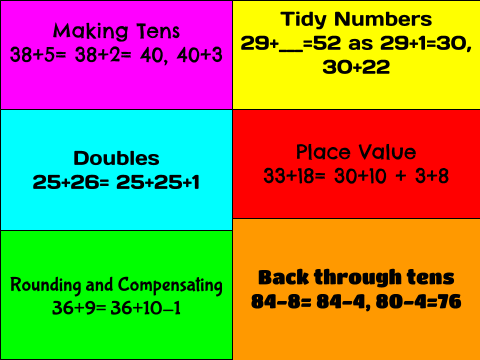
Stage 6 Strategies

Stage 5 Strategies
Stage 6 Strategies
Thursday, 2 July 2015
ALIM: Accelerated Learning in Mathematics

This year, I am very fortunate to have been accepted to this programme. If you'd like to know more about it you can click here.
I have a group of 5 children that I have glossed prior to launching into teaching. My inquiry is "How will a focus on Rich Tasks in Problem Solving contribute to improved learning outcomes for my target students? I will be focusing on teaching fractions, proportions and ratios.
Monday, 29 June 2015
Term 2 Inquiry Reflection
Here is my reflection of my inquiry so far. I have included what has worked well, observations, what needs improving and where to next.
Monday, 1 June 2015
Progress with Integers Group

Without using materials children were able to solve this.
When I posed the question 53 divided by 10, Richard was able to use a different strategy and say that 50 divided by 10=5 and there were 3 left over. He knew that 5x10=50 (reversibility) and knowledge of basic facts.
Another question was 44 divided by 5. Machelle said the answer was 9 remainder 1. She said that 5x9=45-1 =44.
Richard disagreed. He said that 40 divided by 5=8 and there's 4 left over. Machelle had to repeat it back and she could see that was she had shared was incorrect. She showed understanding through discussion.
Saturday, 23 May 2015
Teaching with Integers
You said ______________________, can you explain why did you do that?
Why did you _______________________?
I don't agree because ___________________.
I didn't understand, could you repeat that please?
I also focused on not speaking too much and encouraged the children to speak instead. When a student shared their learning and ideas, I found that a lot of the children tended to agree and weren't really questioning or challenging what was shared.
However, children began to put on their thinking caps and had light bulb "a-ha!" moments. Discussions have been working really well with my Integers group. Machelle is a good example. She is always commenting and asking questions. She would say, "you said ________ but that doesn't make sense because _____________". A few of the children are asking "what strategy did you use?"
By allowing children opportunities to direct the discussion empowers them and gives them ownership of their learning. It also keeps children accountable of tuning in and staying focused.
If children get side tracked during discussion, I redirect them back to the problem and ask them "what is it asking us to do?" If children are confident with their answers, (which is incorrect) I would get them to prove it using materials and prompting them along the way.
This has been a major change in my practice. I'm still learning to remember when to speak and when not too. It's hard but do-able. I'm also still learning to facilitate discussions in my lower ability groups.
Subscribe to:
Posts (Atom)