
Sunday, 28 February 2016
Inquiry Focus in 2016

Wednesday, 9 December 2015
Final Inquiry Reflection for 2015
The following is data based on end of year gloss testing. This is of my maths class, a total of 28 students, nine of which were in my ALIM group.
Things that I would like to focus on for next year: sorting my groups in to mixed ability, focus on fractions and incorporating strands - geometry and statistics.
Things that I would like to focus on for next year: sorting my groups in to mixed ability, focus on fractions and incorporating strands - geometry and statistics.
Monday, 2 November 2015
Alim Impact Day Presenation
I've been privileged to have been part of the Accelerated Learning in Maths 1 programme this year.
A brief overview of the demographics of our school. We are in East Auckland and have a roll of around 650 students. The majority of the children are of Maori and Pasifika background with a small number of Asian and New Zealand European. We are a Manaiakalani cluster school and are a 1:1 digitally immersed. We base our approach on Learn, Create and Share. The resources that I used mainly were from the nzmaths site, figure it out books and the No Nonsense Maths Problem books. One activity that I felt helped with fractions was: Fraction Tagging. My focus question was: "How can I use problem solving with rich tasks to improve the learning outcomes of my target students?"
I initially chose 10 students but 1 student left so I had 9 altogether. The first week was spent setting up a treaty, creating a checklist for students to use when problem solving, having a reflection chart at the end of each lesson and sending home letters to parents.
Grouping students was important. I wanted to split children that were very chatty but also wanted confident children amongst the less confident.
I found that my "Maths Club" became more confident and began sharing their learning in class with other children. They were able to help others too. I also created a google form that I got my students to fill out. Some of the children's responses were that they really loved maths, maths was the only thing they were good at and one student loved maths because he could learn from others.
I mainly focused my teaching around fractions and proportions although I did teach multiplication and division strategies as well.
Thankfully enough, our CAP plan was already in place from previous teachers who had been through Alim so I spent some time going over it again. You'll see the data and my findings in the presentation below. If you have any questions please feel free to comment. Also thank you to Juanita and Sue for helping me along the way.
A brief overview of the demographics of our school. We are in East Auckland and have a roll of around 650 students. The majority of the children are of Maori and Pasifika background with a small number of Asian and New Zealand European. We are a Manaiakalani cluster school and are a 1:1 digitally immersed. We base our approach on Learn, Create and Share. The resources that I used mainly were from the nzmaths site, figure it out books and the No Nonsense Maths Problem books. One activity that I felt helped with fractions was: Fraction Tagging. My focus question was: "How can I use problem solving with rich tasks to improve the learning outcomes of my target students?"
I initially chose 10 students but 1 student left so I had 9 altogether. The first week was spent setting up a treaty, creating a checklist for students to use when problem solving, having a reflection chart at the end of each lesson and sending home letters to parents.
Grouping students was important. I wanted to split children that were very chatty but also wanted confident children amongst the less confident.
I found that my "Maths Club" became more confident and began sharing their learning in class with other children. They were able to help others too. I also created a google form that I got my students to fill out. Some of the children's responses were that they really loved maths, maths was the only thing they were good at and one student loved maths because he could learn from others.
I mainly focused my teaching around fractions and proportions although I did teach multiplication and division strategies as well.
Thankfully enough, our CAP plan was already in place from previous teachers who had been through Alim so I spent some time going over it again. You'll see the data and my findings in the presentation below. If you have any questions please feel free to comment. Also thank you to Juanita and Sue for helping me along the way.
Monday, 14 September 2015
Inquiry Reflection Term 3
Reflecting on what am I trying to address and what impact has it had on student's learning.
Monday, 3 August 2015
Reflecting So Far...
However, after much practice and pulling children's thinking back to the problem and what the problem is requiring them to do, facilitating discussions became easier. Once a student shared, I would give the others in the group a raised eyebrow look and that would signal to them that they needed to ask questions eg. Can you explain how you got your answer?
This rest of the group had to be listening when others were sharing. The children in my Integers group are leading their discussion when problem solving. If the problem is difficult then I would record their thinking on the whiteboard for others to see and this would apply for children that speak quickly. It helps others to take notice and think whether they agree or disagree with the speaker's thinking and answer.
This has changed my practice immensely. I am not talking or leading the discussion as much as I use too.
Where to next? I've focused a lot on teaching strategies through problem solving. I'm now going to focus on teaching number knowledge.
Monday, 27 July 2015
Stage 5 and 6 Strategies
I've been teaching children to recognise the way that they solve number problems and getting them to relate them to names. At the moment both the Integers and Exponents are very familiar and are more able at using Place Value and Tidy Number strategies.
Stage 5 Strategies
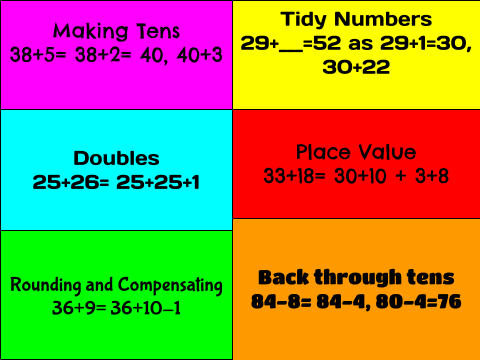
Stage 6 Strategies

Stage 5 Strategies
Stage 6 Strategies
Thursday, 2 July 2015
ALIM: Accelerated Learning in Mathematics

This year, I am very fortunate to have been accepted to this programme. If you'd like to know more about it you can click here.
I have a group of 5 children that I have glossed prior to launching into teaching. My inquiry is "How will a focus on Rich Tasks in Problem Solving contribute to improved learning outcomes for my target students? I will be focusing on teaching fractions, proportions and ratios.
Subscribe to:
Posts (Atom)